.png)
.png)
Project Overview
Affordable Fitness & Nutrition App for Students
Student-athletes often struggle to balance academics, training, and limited budgets, making affordable fitness and nutrition support difficult to access.
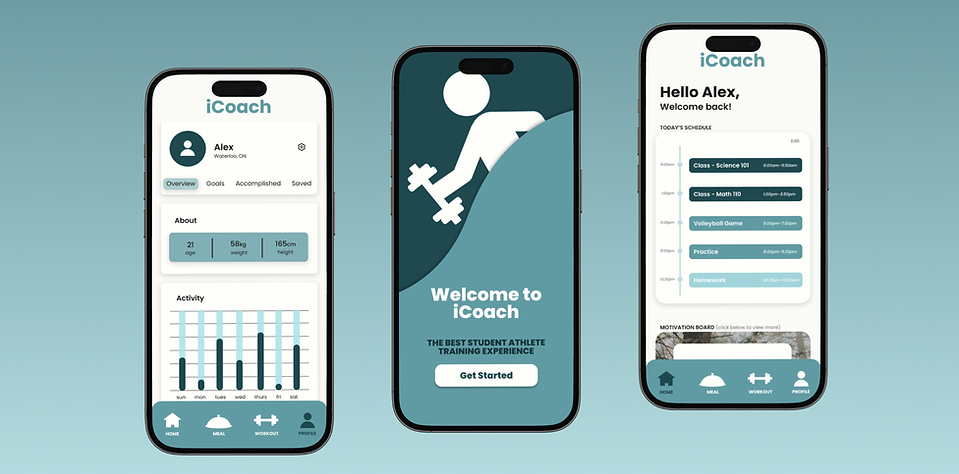
As part of a final design project, our team developed iCouch. A mobile app that provides accessible training plans, budget-friendly diet guidance, and personalized progress tracking, empowering students to achieve their fitness goals with confidence and flexibility.
Timeframe
Team
1 Months
6 Business & Design
Students
(Nov 2023)
Role
Co - Designer
-
UX + UI Design, Visual design, Branding, User flow, Research, Prototyping + Testing
Tools
Figma, Fig Jam, Google Forms, Miro Board

The Challenge
Balancing fitness, nutrition, and academics on a student budget
Student-athletes often struggle to access affordable training and diet plans that fit their busy schedules. Many existing apps are expensive, overly complex, or not tailored to student needs, creating barriers to achieving consistent fitness goals. There is a clear need for a practical, accessible, and student-focused solution that supports healthy habits without financial or scheduling strain.

Objective/Goal
To design a user-friendly, accessible mobile app that empowers student-athletes and students to achieve their fitness and nutrition goals.
The app aims to provide affordable training plans, budget-conscious diet guidance, and personalized progress tracking, making it easy for students to maintain healthy habits while managing academic and athletic commitments.
Research Process
Before designing iCouch, we conducted comprehensive research to understand student-athletes’ needs, identify gaps in the market, and inform the app’s features and interface. Our goal was to create a solution that is practical, motivational, and affordable.
Key Questions
1.
How do student-athletes currently access training and nutrition guidance?
2.
What are the biggest barriers for students in maintaining consistent fitness habits?
3.
Which app features would make a fitness app both useful and motivating for students?
Key Insights
Accessing Affordable Fitness
Student-athletes often struggle to find budget-friendly, flexible training and diet plans that fit their busy schedules, creating barriers to starting or maintaining a routine.
Barriers to Consistent Engagement
Time constraints, academic pressure, and complex nutrition plans make it difficult for students to maintain consistent fitness habits, highlighting the need for simple, actionable, and motivating features.
Demand for Personalized Tools
Students want progress tracking, goal setting, and personalized guidance that provides clear feedback and encourages ongoing engagement, making fitness and nutrition goals more achievable.
Customer Journey Map


Points of View
-
Student-athletes need affordable, flexible training and diet solutions that fit their busy academic and athletic schedules.
-
Students need simple, actionable guidance and motivational tools to maintain consistent fitness and healthy habits.
-
Educational institutions and student programs need accessible, student-focused wellness solutions that support engagement without straining time or budgets.
How Might We
-
How might we provide budget-friendly training and nutrition plans tailored to student-athletes?
-
How might we design simple, actionable tools that help students stay consistent with fitness and diet goals?
-
How might we create a motivating, engaging app experience that supports student wellness alongside academic commitments?
Low - Mid Fidelity Wireframes
The team mapped the flow from account creation to setting goals, browsing training plans, and tracking progress. Low-fidelity wireframes explored layouts and profile interactions, inspired by student-focused fitness apps.


Branding

High Fidelity Wireframes
After finalizing the branding and mid-fidelity wireframes, we designed the high-fidelity screens and built the final prototype. This included interactive simulations of the app experience, allowing us to test the flow, gather user feedback, and refine usability.


Future Impact
Couch represents a step toward supporting student-athletes and students in achieving their fitness and nutrition goals through accessible, user-centered design. The following future directions outline how the app could evolve to create long-term impact on student wellness and engagement.
-
AI-Driven Personalization and Recommendations: AI could deliver personalized workout and meal plans, adapting to individual goals and progress to improve engagement and results.
-
Institutional Partnerships and Program Integration: AI could deliver personalized workout and meal plans, adapting to individual goals and progress to improve engagement and results.
-
Expanded Training Modules and Community Features: Future updates could include diverse workout types, nutrition guidance for different dietary needs, and social features, allowing students to practice healthy habits in a collaborative, motivating environment.
-
Education and Awareness for Healthy Lifestyles: Future updates may include diverse workouts, dietary options, and social features to encourage motivation and accountability.
Prototype

1. User-Centered Research is Key
Conducting surveys, interviews, and competitor analysis highlighted the importance of understanding real student needs. Designing for actual pain points ensures features are relevant, actionable, and truly useful.
2. Iteration Improves Usability
Prototyping, testing, and refining the app based on user feedback allowed us to identify usability issues early and optimize the flow. Continuous iteration is essential for creating a smooth, engaging experience.
3. Collaboration Strengthens Design Outcomes
Working as a team encouraged shared problem-solving and idea refinement, improving both the visual design and interaction logic. Collaboration also reinforced communication skills and empathy within a multidisciplinary context.
Learning & Takeaways :)
Creating iCouch was both challenging and rewarding. The project reinforced the importance of research-driven design, iterative testing, and collaborative teamwork. By focusing on real student needs, gathering and applying user feedback, and working closely as a team, we were able to deliver a more effective, user-friendly, and engaging solution. This experience not only strengthened my design skills but also highlighted the importance of empathy, communication, and adaptability when solving complex, real-world problems.